Finding Strength in the Mission: How 2025 Grant Recipient Savanna Kept Going
As the deadline for the Leave Your Mark Contest approaches on September 13th, it is easy to assume your story is not big enough or finished enough to...
6 min read
.png?width=1800&height=1200&name=7%20Hurricane%20Myths%20Blog%20Photo%20(900x600).png)
Hurricanes can create serious travel disruption, but coverage is not automatic. Benefits often depend on timing, policy language, documentation, official orders, and whether the traveler contacted assistance before making major decisions.
Hurricane season can create a lot of “what if” questions for travelers.
What if my flight is canceled?
What if my hotel closes?
What if my destination is under an evacuation order?
What if I am already there when the storm hits?
What if I feel unsafe and want to cancel?
What if I need medical care during or after the storm?
These are exactly the kinds of questions travelers and group leaders should ask before they travel.
The mistake is waiting until a storm is already approaching to start asking them.
MissionSafe’s Safe Passage case study on Hurricane Melissa shows why timing, documentation, coverage type, and assistance coordination matter. In 2025, Hurricane Melissa became a Category 5 hurricane with sustained winds of 185 mph and caused major disruption across Jamaica, Haiti, Cuba, the Bahamas, and Turks & Caicos, including flooding, power outages, communication blackouts, damaged hospitals, restricted air travel, and infrastructure damage.
When severe weather impacts travel, the question is not simply, “Is there coverage?”
The better question is:
What does the policy say, when was the policy purchased, what happened, and what documentation supports it?
Not necessarily.
Coverage depends on the policy, the timing, the reason for the disruption, and the documentation available.
A hurricane may be covered in one situation and not covered in another. For example, official evacuation orders, travel advisories, property damage, canceled flights, or medical necessity may all affect whether benefits apply.
That is why it is important to review your coverage before you travel, not after a storm starts affecting your plans.
This is one of the biggest mistakes travelers can make during hurricane season.
Once a storm is publicly named or becomes a known event, new policy purchases generally exclude that event and coverage will not apply to the effects of that storm.
If you are traveling during hurricane season, buy coverage early.
Maybe, but maybe not.
Feeling uncomfortable about traveling toward a storm-affected destination is understandable. But fear or inconvenience alone may not qualify for benefits unless your plan includes a benefit that applies to that situation.
Some cancellation benefits require specific covered reasons. Some natural disaster benefits may require government orders or verified property loss. Some plans may offer broader flexibility, but you need to know that before the storm.
This is why trip cancellation coverage should be discussed early, especially for travelers with prepaid and nonrefundable expenses.
Not always.
This is an important distinction. Emergency medical evacuation usually means medically necessary transport to the nearest qualified medical facility when local care is unavailable or unsafe. It does not automatically mean return home. Evacuation is not the same as repatriation. Evacuation means transport to the nearest qualified facility, not automatic return home.
That may surprise travelers, but it is an important part of understanding how coverage works.
They do not.
Travel medical coverage supports medical needs while traveling. Trip cancellation coverage may help with eligible prepaid trip costs if a covered event prevents you from traveling. Trip interruption coverage may apply once travel has already started, depending on the policy and circumstances.
During hurricane season, layered protection can be important because a storm may create both medical and non-medical disruptions.
The Hurricane Melissa case study notes that trip-cancellation products can complement travel-medical coverage.
Here is a simple way to think about it:
|
Coverage Type |
What It May Help With |
|
Travel medical coverage |
Illness or injury while traveling |
|
Emergency medical evacuation |
Medically necessary transport when local care is unavailable or unsafe |
|
Trip cancellation coverage |
Eligible prepaid costs if a covered event prevents travel before departure |
|
Trip interruption coverage |
Certain eligible expenses if a covered event disrupts travel after the trip has started |
|
Natural disaster benefits |
Certain costs after official evacuation orders or verified property loss, depending on the policy |
Every plan is different, so travelers should review the details before departure.
Hurricanes can disrupt domestic travel too.
Florida, the Gulf Coast, coastal Georgia, the Carolinas, Puerto Rico, the Outer Banks, and many other U.S. destinations can all be affected by tropical weather.
Domestic trips may still involve flights, hotels, rental cars, prepaid activities, medical needs, group responsibility, evacuation orders, and unexpected expenses.
If you are traveling during hurricane season, preparation matters whether you are leaving the country or staying within the United States.
Group leaders are capable, but they should not be left to improvise during a crisis.
When a storm affects group travel, leaders may need to account for every traveler, communicate with families, monitor advisories, coordinate transportation, store documentation, manage expenses, contact assistance providers, and make decisions under pressure.
That is a lot to handle without a plan.
The Hurricane Melissa case study includes a risk-management checklist specifically for group leaders, and it is worth building into travel planning before departure.
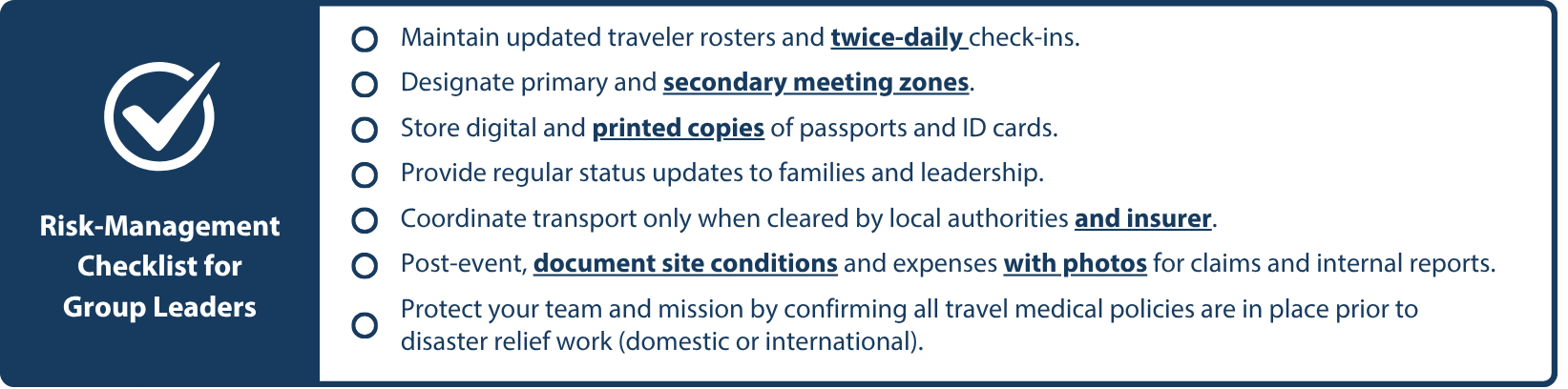
A hurricane response plan should not live in one person’s head. It should be documented, shared, and accessible.
Your priorities change depending on whether a storm threatens your trip before departure or while you are already traveling.
The Hurricane Melissa case study includes a helpful comparison of what to focus on in each situation.
|
Scenario |
Before You Leave |
Already Traveling |
|
Main focus |
Verify advisories, delay non-essential travel, confirm policy effective date |
Move to safe shelter, contact assistance, maintain communication |
|
Benefit questions |
Check whether advisories or known event timing affect benefits |
Medical, evacuation, natural disaster, or trip interruption benefits may apply |
|
Natural disaster benefits |
Usually not triggered before departure |
May apply after official evacuation orders or covered displacement |
|
Emergency medical evacuation |
Usually not applicable before departure |
May apply if local care is unavailable and transport is medically necessary |
|
Trip interruption |
Usually applies after travel has started |
May help with return-home expenses in certain covered situations |
|
Traveler priority |
Reschedule carefully and retain advisory records |
Follow directives, document expenses and orders, coordinate through assistance |
The simple version: Before you leave, your goal is to avoid walking into an unsafe or unsupported situation.
Once you are already traveling, your goal is to get safe, communicate clearly, document everything, and coordinate with assistance before making major decisions.
If a hurricane or tropical storm affects your travel plans, here is the order we recommend.
.png?width=611&height=356&name=ChatGPT%20Image%20May%204%2c%202026%2c%2003_16_11%20PM%20(3).png)
Follow local authorities, hotel instructions, airport updates, emergency alerts, and group leader guidance.
If there is a warning, curfew, shelter-in-place instruction, or evacuation order, take it seriously.
Your itinerary can be fixed later. Your safety comes first.
Before making major travel changes, paying significant expenses, or attempting to evacuate, contact the 24/7 assistance line whenever possible.
Ask what steps you should take, what documentation to keep, and whether anything needs to be authorized.
Need your emergency numbers? Visit the Traveler's Toolbox for your one-stop resource hub. Screenshot numbers and bookmark the page before you go!
If you are traveling individually, update your family or emergency contact.
If you are leading a group, create a simple communication rhythm. Let travelers, families, and leadership know when the next update will come. Even a short update can help:
“We are safe, we are sheltering in place, and we will update again at 6 p.m.”
Clear communication helps reduce confusion and panic.
Save receipts, cancellation notices, evacuation orders, airline emails, hotel notices, photos of conditions if safe, and written instructions from authorities.
These records may be needed later for claims, internal reporting, or post-trip review.
The Hurricane Melissa case study advises travelers not to self-evacuate unless cleared by authorities or the insurer.
This matters for safety and for coordination. Roads may be unsafe, transportation may be limited, and coverage may depend on proper authorization or documented circumstances.
Before traveling during hurricane season, ask:
|
Question |
Why It Matters |
|
Was coverage purchased before a storm was named? |
Timing can affect hurricane-related benefits |
|
What hurricane-related events are covered? |
Not every weather disruption qualifies |
|
Do we have trip cancellation coverage? |
Prepaid, nonrefundable costs may be at risk |
|
Do we have trip interruption coverage? |
The storm may affect travelers already in destination |
|
Do we have travel medical coverage? |
Medical access may be limited during severe weather |
|
What documentation is required? |
Receipts, advisories, and orders may support claims |
|
Who should travelers call first? |
Assistance coordination may affect next steps |
|
For groups, who communicates with families? |
Clear communication reduces confusion during disruption |
Hurricane season travel is not something to be scared of, but it is something to take seriously.
A storm can disrupt flights, lodging, transportation, medical access, and group communication. It can also create complicated coverage questions if travelers are not prepared.
The best time to understand your options is before the forecast becomes urgent.
Buy coverage early. Know what your plan includes. Consider trip cancellation coverage for prepaid costs. Save the assistance number. Monitor official advisories. Keep documentation. And if a storm impacts your trip, call for help before making major decisions.
Start with our practical guide: Traveling During Hurricane Season? 6 Tips Before You Go & Safe Passage: Hurricane Melissa.
Then use this myth-busting guide to understand the coverage questions travelers and group leaders often miss.
Whether you are planning a family vacation, mission trip, student program, group retreat, conference, or disaster relief response, MissionSafe can help you think through the coverage and support you may need before hurricane season disrupts your plans. Contact our concierge service team today to purchase and review your coverage.

Disclaimer: MissionSafe provides this article for educational purposes to help travelers better understand common travel coverage considerations during hurricane season. This is not safety, legal, medical, or emergency response advice, and it does not guarantee coverage or claim payment. All coverage determinations are made by the applicable insurance carrier based on the policy terms, purchase date, documentation, destination, and specific facts of the event. Travelers should follow official safety instructions from local authorities and contact their travel assistance provider or insurance carrier for guidance related to their specific trip.
As the deadline for the Leave Your Mark Contest approaches on September 13th, it is easy to assume your story is not big enough or finished enough to...
With the Leave Your Mark Contest deadline approaching on September 13th, it is easy to assume you don't have enough time to put together a solid...

Meet 2025 Leave Your Mark Grant recipient Megan Parham Mwenda and learn her story of why she finally decided to apply.