
Top Holiday Travel Destinations for Every Kind of Traveler
Discover top holiday travel destinations for every type of traveler, from festive cities to relaxing beaches, ensuring a memorable seasonal getaway.
4 min read

When a traveler needs hospital care abroad, attention naturally turns to treatment, family updates, and immediate decisions. Insurance paperwork may feel like something to handle later.
But some insurance requirements need attention while care is underway. Pre-certification is one of them. Understanding when to contact your carrier can help you avoid missed requirements, reduced benefits, and complications during an already stressful situation.
For travelers, group administrators, and trip leaders, it is an important part of preparing for medical care abroad.
Pre-certification is an insurance carrier’s review of whether certain medical services are medically necessary. It typically involves information from the traveler and treating medical providers about the condition, proposed treatment, and care required.
Depending on the plan, this process may also be called precertification, prior authorization, or preauthorization. Follow the definitions and instructions in your own policy.
Pre-certification does not guarantee coverage or payment. A service can be medically necessary and still be subject to exclusions, benefit limits, or other policy requirements. For example, MissionSafe partner IMG expressly distinguishes its medical necessity review from a guarantee of payment.
Pre-certification also does not replace filing a claim. You may still need to submit claim forms, medical records, itemized bills, and proof of payment.
The list varies by insurance carrier and plan. Services to check include:
Evacuation and other assistance benefits may have separate requirements for advance approval and arrangements through a designated assistance provider.
Do not assume that two plans from the same carrier have identical requirements. Review the certificate issued for your coverage and contact the carrier when you are unsure.
Seek necessary emergency medical care immediately. While treatment proceeds, a trip leader, family member, or medical provider can contact the insurance carrier or designated assistance provider.
Emergency notification deadlines vary. Your policy may specify a deadline after admission and include instructions for circumstances in which notification is not reasonably possible within that period.
For example, the IQ Gold certificate requires pre-certification for an emergency hospital admission within 48 hours after admission, or as soon as reasonably possible. That is a requirement of this particular plan, not a universal deadline for travel insurance.
For planned care, contact the carrier before receiving services that require pre-certification. If treatment changes or hospitalization continues beyond the initially reviewed period, ask whether another review is needed.
The consequences depend on the policy and service. Missing required pre-certification may reduce eligible benefits or leave a service without coverage.
MissionSafe's proprietary IQ Gold Plan illustrates why it is important to read beyond a general reminder to “call your carrier”:
| IQ Gold example | Consequence of missing the requirement |
|---|---|
| Treatments and supplies subject to the general pre-certification reduction | A 50% reduction in eligible medical expenses, before applicable deductible and coinsurance |
| Interfacility ambulance transfer | No coverage if pre-certification requirements are not met |
| Emergency medical evacuation | No coverage if not approved by the company |
Your plan may use different rules, reductions, or exceptions. The practical takeaway applies broadly: confirm which services require review, when to contact the insurer, and who must arrange them. When in doubt, call your carrier.
Having an emergency medical evacuation benefit does not necessarily mean you can arrange transportation yourself and submit the bill afterward.
A policy may require medical review, a physician’s recommendation, advance approval, and transportation coordinated by its designated assistance provider. The destination may be the nearest facility that can provide appropriate treatment, rather than the traveler’s home country or preferred hospital.
IQ Gold, for example, includes specific medical eligibility conditions and requires advance approval and company coordination.
Contact the designated assistance provider as soon as evacuation becomes a possibility. Follow its emergency instructions rather than relying on a routine online request. IMG specifically directs travelers to call for emergency evacuation assistance and says its online pre-certification form should not be used for emergency admissions, procedures, or evacuations.
Start with the assistance number on your insurance ID card or policy documents. Explain the situation and ask what is required for the treatment being provided.
Helpful information includes:
Do not postpone the initial call while trying to collect every detail. Ask what information can follow and keep a record of conversations, reference numbers, and instructions.
If the hospital requests payment arrangements, ask about the carrier’s process. Pre-certification and a Guarantee of Payment are separate matters; completing one does not establish that the other is in place.
Make insurance procedures part of your travel preparation. Confirm that travelers and leaders can access ID cards, emergency assistance numbers, and plan documents, including when internet service is unavailable.
For groups, identify who will contact the carrier, communicate with family members, and retain medical documentation. Confirm that required pre-certification has been completed rather than assuming someone else has handled it.
MissionSafe can help you understand your plan’s procedures and support communication when an incident occurs. Required medical reviews and approvals must still come through the carrier or designated assistance provider.
For travelers with applicable IMG coverage, our Pre-Certification Information guide provides contact instructions and a list of information to gather. Travelers with other carriers should use their own plan’s instructions.
Download the Pre-Certification Information Guide
Use the Medical Emergency Checklist to review response steps with your travelers and trip leaders before departure.
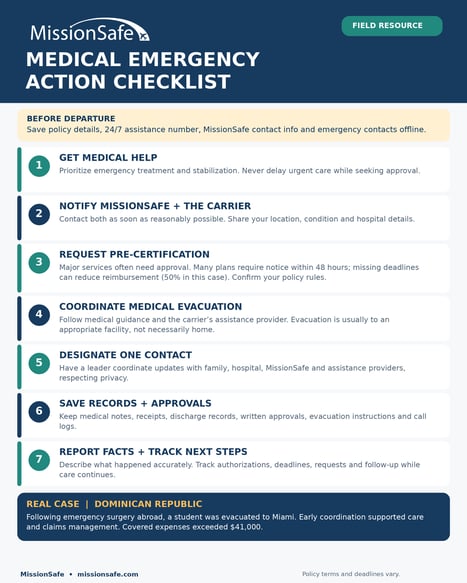
Download the Medical Emergency Checklist
Requirements vary by carrier, plan, and policy version. This article provides educational information; the traveler’s issued policy governs coverage, deadlines, approval requirements, limitations, and exclusions. The carrier makes coverage and payment decisions.
Discover top holiday travel destinations for every type of traveler, from festive cities to relaxing beaches, ensuring a memorable seasonal getaway.
Prepare for the busiest travel week of the year this Thanksgiving with essential tips to ensure a smooth journey and quality time with loved ones.
Prepare for Halloween travel with tips to avoid common nightmares like flight delays, lost passports, and mishandled luggage to ensure a stress-free...